The Turbulent Jesus Hidden in the Water
The Turbulent Jesus Hidden in the Water
On healing cultural relationships to land and its histories of violence and displacement with the Body
1 disembodiment
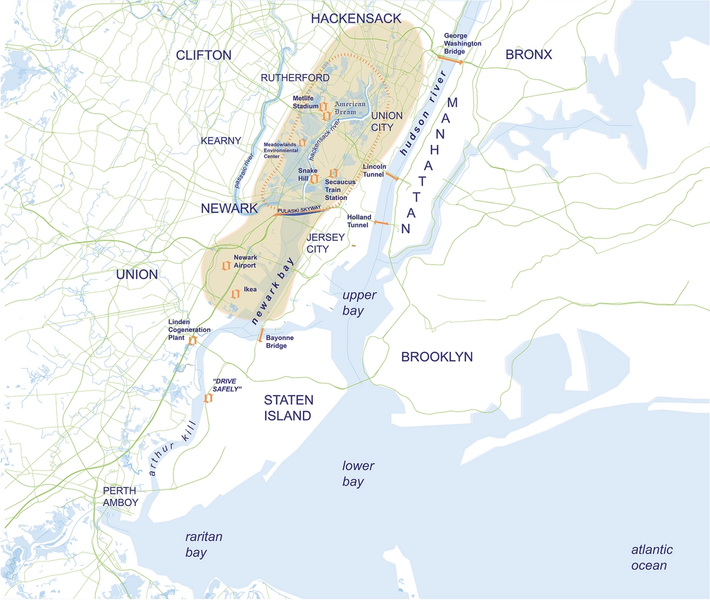
I grew up on a pavement carpet laid with a violent eye atop a wetland. The ill-fitting city with its gaze is fixed away from the poisoned waters beneath in an absurd gesture of denial.
A settler-colonialist construction built on the dispossession of the Lunaape people, today still ruled by colonial inheritors and inhabited by a mix of the displaced, their descendants, and the willingly relocated, stewed together into a population in a constant multi-generational flow of arrival and setting forth. It’s a place riding the surface of its land, a cowboy on the back of a bull.
But in the below, the within, the infusion throughout -- the spirits still live. They hibernate in muddy entrails, they alight in smokestack plumes, they kiss the morning in glistening sunlit trails across the water’s surface, they bubble up through the city’s sewers to spill out into its streets. Their vitality reveals the tragedy of those who refuse to hear them.

2 possession
Eventually you reach the age of longing for deeper submersion into the business of living, while still being young enough to be held within the scaffoldings of childhood. I would find myself again wandering the industrial byways, would drive the paths carved through the wetland, asphalt entrails to industrial corpses and barbed wire fences enshrouding the living.
The sensations I found there were overpowering. Almost every time, I would feel this hunger, this urge, to simply sublime my being. An ecstatic dissolution of my self was the only expression that would satisfy. I still feel it – to levitate above the landings staring up at a smokesack and feel the air, the light, the smog, the smudge, the thick of it tearing me apart. Whatever was there didn’t need me – quite the opposite – but if I was going to be there it was damn well going to use me, it was gonna fill me up, a willing, porous naïve, ignorant vessel. And use me it did. It drove me.
It happened - it got loose inside of me and filled me up to bursting. The *feeling* of it. It was inside my blood, my bone marrow, pouring out silently through my open mouth. Once that happens, as far as I understand, there’s a choice. Try to bury it and become even sicker, or integrate it, integrate it so deeply until it’s in every breath, every twitch of a finger.
Eventually I reached a point where the path forward was to go back. I had to go back. It was like being caught in a mess of invisible snares. No other steps made sense other than to turn towards home; anything else would have been to operate from paper ground. “If I’m trying to change culture,” I would say, “I have the best chance of learning how at home, with my people.”
Ecological revolutions as defined by Carolyn Merchant are processes “through which different societies change their relationship to nature.” We are in the middle of one. Just like climate change is streaming towards us, so too is the revolution.
It took time for my fumblings to become unburdened by distance. The demeanors of landscape practice I had been educated in call for distant, measured dissection and prescription. The practitioner themselves has no body. They don’t sweat, poop; no, they articulate, diagram, preposition—they are their instruments, and the instruments are correct.
It took effort to escape from this; to slip out of the casings that had been constructed in my own mind. Down and out and into the underneath, where true connection becomes possible. Into the luxury void - the space of all potentials and nothing realized. To re-emerge slowly—to swim in that space and slowly emerge into the land of the living, re-bodied, with the capacity to to be a vessel with its own Selfhood. Not a ghostly vessel through which things flow, but a metabolizing body with its own poop.
3 For disembodied settlers: a method for forming a body / entering the body
In the journey from the underworld to the land of the living, a structure began to reveal itself – a sacred geometry of land-human relationships. In each, the ways in which land was held shifted, cultural metabolisms occurred at different speeds and with different lineages, and the invitation offered to me shifted. My roles played in polyphony — a student, a servant, a supplicant, just one of the gang.
i. land - settler body (transformation of the self)
First, I must enter the temple. I must have a body to do so, a body to walk with, to lay before the altar, my knees in the mud and fingers entwined in the reeds. Yes, I had before been possessed by the land - but where was I during the possession? It is necessary to shift from a skin filled to the extent that it longed for its own sublimation to a container that fills yet retains form, because it is also full of some acknowledged essence of itself. The form is not static - it flows, shifts, mutates in resource response.
I am a child of immigration. That is to say — I am a child born outside of the lands that shaped the cultural behaviors of my families. I am an inheritor of a lineage that has now lived multiple generations away from the land that birthed our ways, our minds. There is a groundless disembodiment in this, and that can be painful and dysfunctional for the family. Equally, it can be harmful for the land we have settled in. Unaware of the extent of our wounding, of the void once filled by ecological intertwinement, we do not grasp the necessity of reaching into the place we now find ourselves and weaving ourselves into it, defining a new set of relational practices and a new cosmology, that metabolizes together who and where we have been and where we are now. Until we do that, we will remain in a disembodied, detached state and thus capable of behaviors that harm our new home and neighbors.
I had long had a practice of roaming of sitting in sites of damage, roaming them, going where I shouldn’t go under the belief that the presence of myself there was a form of witness and a rejection of the system of controlled extraction laid over the land. But this practice had been immaterial, ghostly, I a being of no particular form other than being present - and even in that, often trying to shirk around and hide from view. I began to shift into moving with more presence, more sense of being a particular body, with a particular shape. The true nature of the work began to reveal itself: becoming embodied. No longer a ghost myself, but a present vessel through which ghosts are invited to meet and reconcile.
I began to weave the Catholic cosmologies of my upbringing into the histories of violence and regeneration of the land. My baptism in the Hackensack River was on April 5, 2021 - Easter Monday, the day after Jesus’ ascension, and my birthday. It was preceded by a three-day ritual that followed the arc of Jesus’ crucifixion, burial, and resurrection, mapped onto sites of sorrow and regeneration. Good Friday - at Bayway Oil Refinery & (that other place), allowing myself to enter in trance state and from there converse with the spirit of the place. Holy Saturday - resting in the parks of the city. Easter Sunday - in trance, ascending to the top of a former landfill, now covered in grasses, to remove my garments of sorrow at the top. For the first time - naked in the land. And Easter Monday - my baptism. I stood at the shores of the Hackensack River beneath the heaping arches of the New Jersey Turnpike, and acknowledged that all these years this place had been speaking to me and through me.
I spoke of my readiness to serve, and to do so as a body - holding with my proud back and my strong step its message. And I asked for its embrace as I did so. The consecrating act of stepping out into the water, my feet being swallowed by mud, and amongst the rusted wreckages submerging too my flesh. Once — twice — then called to shore by my lover to be wrapped in blankets, kissed, and made ready to face the day of celebration.
ii. land - emergent culture (festival and emancipation)
I'm telling you that Jesus was a b-boy.
For I too have seen the burning bush and smoked it.
Jemeni, from "Jesus was a B-Boy" (music and production by Ben Mono)
I had already understood the role of festival as a mechanism through which the collective gathers itself to face in conversation the underneath, the within, the pulse that moves through all, and in so doing to step outside the grasp of the authority that governs, that defines, includes and excludes, binds, constrains, define, categorizes, and limits. And finding itself beyond the blindnesses of authority, at last lives the dream of intimate liberation made real. I believed that through festival, treasured and fearful illusions of distance could be brought to a safe collapse; a disembodied people could be brought into integration with land and its painful stories. Festival is cultural consciousness made manifest, and thus a site for transformation (Merchant).
In wanting to solve the problem of the disembodied settler, I was led to be a student, to learn from and serve people who had, finding themselves forcefully displaced and dispossessed, grown a multi-generational emergent culture rooted in the soil beneath the colonial palace itself.
It began on Main Street (Newark Avenue, Jersey City). A sound system had been plugged into a city light pole, and a mid-pandemic dance party blossomed. That evening I met Jyce -a dancer, artist and steward of the underground in Jersey City and its urban network. Jyce was my first invitation and guide into the constellation of cultural forms that pulsed in articulation of the city’s breath - house music and dancing, hip-hop music, breakdancing and graffiti.
Birthed by the city’s Black communities, Latino communities, these forms were birthed from ancestries of enslavement, colonization, forced migration. They grew forth from people living in the seat of the colonial empire, and as cultural forms they refused the distanced stance the empire was built on. Instead, they spread throughout the city, seeking its unwatched corners and subterranean caverns, knitting them together into a powerful energetic mesh. They articulated its tyranny and the shape of its violence, spoke with the sounds of its technological obsessions, and called forth the beauty and joy intrinsic and unconquerable, still wild in the air, the soil, and the spirit, in spite of all the empire’s attempts to harness it to its own ends.
Jyce, J-La Rok and I became a roving, bicycle-born street party. Dreaming of off-grid parties, I had invested in a high-volume battery-powered speaker. We fashioned a bicycle cart for it, strapped on Jyce’s DJ equipment, and added our offering to the vernal pools of pandemic outdoor parties. I was often unsure how to move my body. This was not the offshoot realm of international club culture, much more likely the purview of the young, often white, like myself. Though I had spent time in the club scene, had danced to house music for hours at a time, this was different and new for me, and it put me into direct confrontation with my disembodiment. Here was the music as it truly was - integrated into place and time, into multi-generational lineage, and directly emergent from the rhythms of living.
Where I could, I made offerings. I moved in gratitude. I was a student. I studied how to be bodied - to feel the substance of my own being in my core, and to allow that to be the basis from which I opened myself to surrounding energies, and to give me the footing to offer an open heart and an easy smile.[1]
...communal dancing reveals divisions, categories, inequalities, and laws to be arbitrary and meaningless, and is a convivial activity inherently corrosive of top-down authority. — DJ Shao
The culture of party, of communal dancing, that has locally emerged from the urban strongholds of the colonial empire, within the communities of the oppressed, is a healing force. It denies the dynamics of distanced dissection, and provides a language through which the body makes intimate sense in relation with the spirits that surround. It is a cultural form emergent from land in which the indigenous peoples, and their long-lineaged cultural containers for holding and moving with the rhythms and entities of place, have been violently removed, leaving those rhythms in dysfunctional relationship with their new colonial inhabitants. The displaced and dispossessed who now live in that land, through the generating of cultural tradition particular to place, sew up the wounds of the rifts. The communities generated are to be protected, learned from, and uplifted in their healing capacities.
iii. land - indigeneous culture (indigeneous sovereignty)*
land back – indigenous sovereignty / justice / restoration .
riding in the 4-wheeler w/ Curt
Someone who can ignite you into their home
*(remains to be written)
4 in the land of the living
How these different methods make a home for spirit, for the memories and ghosts of violence to be embodied, in different ways, and the weaving of them together corrects some aspect of separation, me being in my bubble.
To hasten the fall of empire through undermining its disconnection and domination and building right relationship. To acupuncturedly bring about the ecological revolution – supporting those who engage in this same struggle. My being is on the operating table in this, splitting myself open to seed in me what needs to be there, to remove and reweave what needs to be removed, rewoven.
[1] Learned a lot from Tada Hosumi here
Larissa Belcic
Larissa Belcic is an artist, designer, researcher and intuitive from northern New Jersey/occupied Munsee Lenape land. Their ancestry contains three branches that meet in West New York, New Jersey; immigrant settlers from Udine and Sicily (Italy); and Istria (Croatia). Belcic is a cofounding principal of Nocturnal Medicine, a nonprofit design studio working to transform cultural relationships with the environment through experience design and installation. As a landscape practitioner, Belcic is committed to full-being practice that locates, implicates and entangles the self. Belcic’s work often takes on the shadow side of the contemporary environment, highlighting polluted lands, waste and energy infrastructure and outer- space colonization. They have worked as a designer and researcher with TerreformONE, OFICINAA and New Jersey’s Melillo Bauer Carman. They have an MLA from the Harvard University Graduate School of Design and a BA in Linguistics from Boston College, and they are trained as a death doula.